


Reframing ESG Through Housing Solutions and Workforce Well-being
For years, ESG reporting in industrial development has focused mainly on energy efficiency, carbon footprint, and waste management. Yet, within this global sustainability narrative, one vital element, worker housing and accommodation solutions, has remained largely unaddressed.
The “S” in ESG, representing the Social dimension, measures how organisations support their workforce, communities, and broader human wellbeing. In the context of industrial real estate, this translates directly into how employees live, commute, and connect with their surroundings.
Today, a worker housing solution represents a strategic imperative, not only for compliance but for long-term retention, productivity, and ethical industrial growth.
Why Worker Housing and Accommodation Matter to ESG Impact
Industrial ecosystems depend on their workforce as much as on machinery, utilities, or infrastructure. Yet most ESG frameworks have historically concentrated on environmental or governance indicators, leaving the human and accommodation aspects underrepresented.
The Human Side of Sustainability
Integrating employee housing solutions into ESG practice extends sustainability beyond green energy or water conservation. It captures measurable factors such as inclusivity, health, and retention, tangible outcomes that define social sustainability.
This approach aligns directly with UN Sustainable Development Goal 11 – Sustainable Cities and Communities, calling for “inclusive, safe, resilient, and sustainable” living environments.
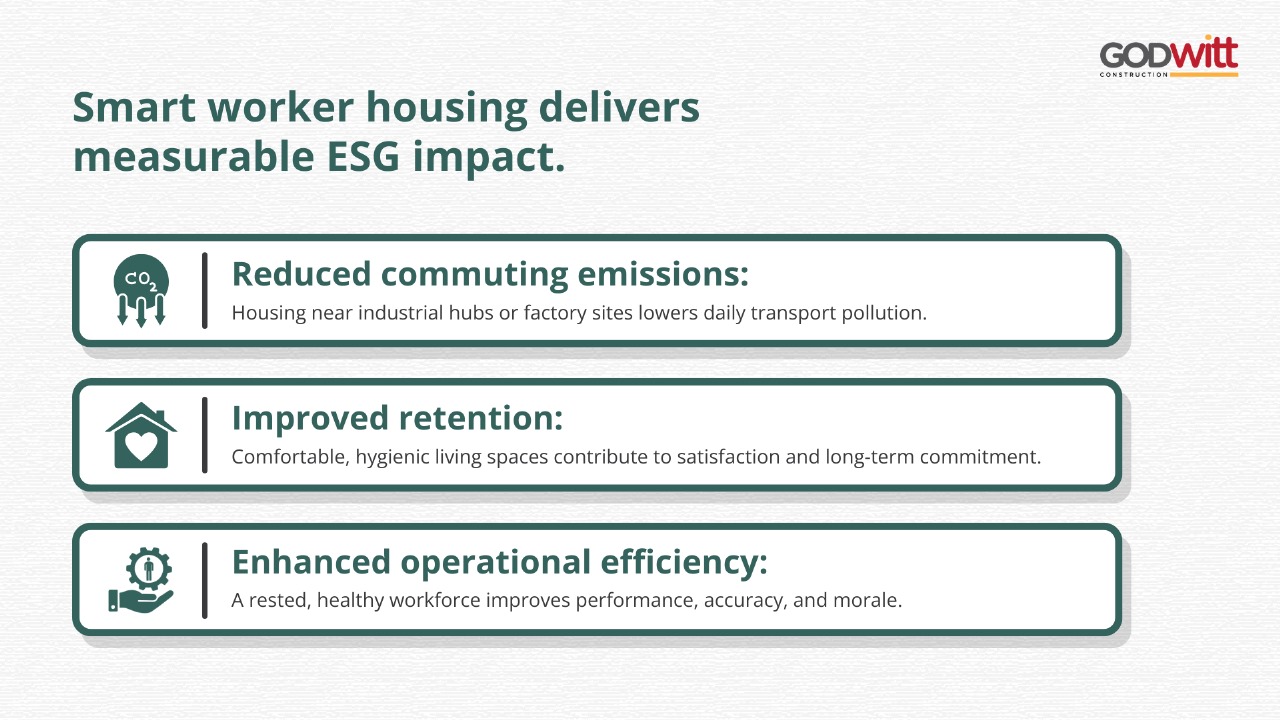
By investing in accessible and well-designed worker accommodation, industrial developers can achieve measurable ESG impact:
- Reduced commuting emissions: Housing near industrial hubs or factory sites lowers daily transport pollution.
- Improved retention: Comfortable, hygienic living spaces contribute to satisfaction and long-term commitment.
- Enhanced operational efficiency: A rested, healthy workforce improves performance, accuracy, and morale.
These are not abstract concepts; they represent quantifiable metrics in sustainable housing management and workforce strategy.
From Welfare to Data: Turning Accommodation into Measurable ESG Performance
Modern ESG standards increasingly seek quantifiable metrics for the Social pillar. Integrating employee housing services into these frameworks transforms welfare initiatives into measurable data.
A housing management system that monitors occupancy, maintenance requests, and living conditions can now be integrated into ESG audits, translating worker housing into a key performance dimension.
Addressing Global Housing Challenges in Industrial Sectors
The housing challenges faced by the industrial workforce are not unique to India; they are a global issue. In many manufacturing regions, from metropolitan areas to developing industrial corridors, a lack of suitable, affordable housing affects recruitment, relocation, and retention.
In India alone, more than 312 million workers have registered on the e-Shram portal as of September 2025, indicating the vast scale of the national workforce dependent on stable and affordable housing infrastructure.
At the same time, India’s urban labour force participation rate rose to approximately 55 percent in mid-2025, underscoring how critical accessible housing near industrial clusters has become.
In response, forward-thinking industrial developers are adopting scalable housing solutions and employee accommodation frameworks that align with SDG 11 and enhance business competitiveness.
Case Studies: Human-Centred Design in Industrial Accommodation
At Godwitt Construction, sustainability is not a checkbox, it is a guiding principle. Through projects like Ikoi by Godwitt, we are redefining what it means to build worker housing solutions within industrial parks.
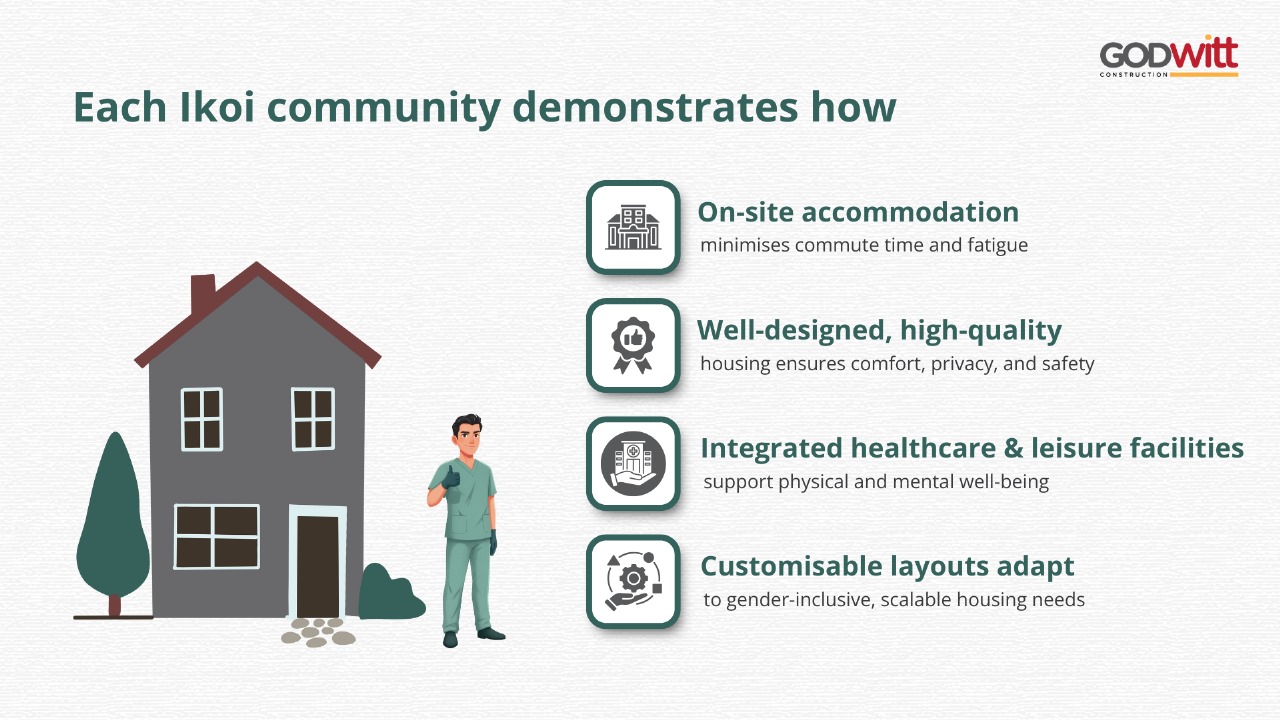
Each Ikoi community demonstrates how employee housing solutions can enhance productivity and retention:
- On-site accommodation minimises commute time and fatigue.Well-designed, high-quality housing ensures comfort, privacy, and safety.
- Integrated healthcare and leisure facilities support physical and mental wellbeing.
- Customisable layouts adapt to gender-inclusive, scalable housing needs.
These case studies prove that responsible infrastructure can drive higher productivity and retention while strengthening ESG credentials.
Scalable Employee Housing Solutions for Modern Industry
Industrial growth requires flexible, scalable housing solutions that can evolve with shifting workforce numbers and project durations. Short-term projects demand temporary housing, while long-term factories require permanent, affordable housing communities.
By deploying modular and customizable housing options, developers can optimise occupancy, streamline housing management, and ensure compliance with safety and welfare standards.
Scalable housing also supports recruitment and relocation by offering proximity-based accommodation, essential in regions with limited local housing. This adaptability enhances both operational efficiency and employee satisfaction.
The Economics of Workforce Housing and Retention
Investing in workforce housing directly improves operational performance. Housing near factory sites enhances time management, reduces absenteeism, and lowers attrition rates.
Employee retention is not only a social metric; it is a business outcome. When companies provide secure, well-managed accommodation solutions, they build loyalty and minimise the costs associated with frequent recruitment or relocation.
In ESG terms, retention, safety, and wellbeing translate into measurable impact, contributing to stronger governance and sustainable profitability.
Employee Housing Management: Beyond Maintenance to Strategy
Traditional housing management models focus on maintenance and compliance. However, progressive industrial developers now view it as a workforce strategy that integrates design, safety, and wellbeing.
Modern housing management platforms can streamline operations through digital dashboards, tracking space requirements, occupancy, and maintenance requests. Such systems simplify reporting and ensure that living conditions align with ESG benchmarks.
At Godwitt, we see housing management not as a logistical task but as a sustainability function that directly influences productivity, retention, and workforce satisfaction.
Global Reference: Aligning Industrial Housing with SDG 11
The UN’s Sustainable Development Goal 11 sets the foundation for responsible urbanisation, and industrial developers play a vital role in achieving it.
By designing employee housing solutions that are safe, affordable, and environmentally considerate, companies contribute directly to SDG targets on housing, resilience, and inclusivity.
This approach transforms industrial parks into mixed-use, human-centred ecosystems, spaces that foster community, improve quality housing standards, and advance global competitiveness.
Building for Sustainable Scale: Godwitt’s Approach
At Godwitt, sustainable development and responsible growth are at the heart of every project. Across our Soko, Reizo, and Ikoi developments, sustainability informs design, execution, and long-term utility.
Our worker accommodation solutions are crafted to deliver:
- Affordable housing for diverse workforce segments
- Tailored solutions that address regional and cultural housing challenges
- On-site employee housing integrated with industrial utilities
- Environmentally responsible materials and renewable energy systems
By embedding housing within our industrial parks, we align ESG compliance with human dignity, ensuring that progress and compassion coexist.
Recruitment, Retention, and the New Competitive Advantage
In the global business environment, talent retention has become as critical as capital investment. A robust employee housing solution can serve as a competitive advantage for companies aiming to attract and retain skilled labour in remote or developing industrial areas.
When accommodation meets international standards of hygiene, safety, and comfort, companies enhance both employee satisfaction and global talent recruitment potential.
The correlation between housing for employees and workforce stability is well-documented: better living conditions produce higher productivity, stronger morale, and lower turnover.
Towards a Global Standard for Worker Accommodation
As multinational industries expand across India and beyond, the need for globally aligned worker housing standards is becoming more urgent. Industrial developers must deliver high-quality housing that supports diverse, mobile, and remote workforces.
From short-term projects to long-term industrial hubs, the ability to build accommodation that is flexible, affordable, and inclusive will define the next phase of industrial ESG leadership.
Manufacturers and other companies who prioritise living standards will not only meet ESG benchmarks but also unlock measurable productivity and retention gains, driving sustainable competitiveness at scale.
Conclusion: Building Beyond Compliance
Worker housing is not a peripheral concern; it is the missing link in ESG. By integrating accommodation, housing solutions, and employee housing management into industrial planning, developers can shift ESG from reporting to real-world impact.
At Godwitt, our vision is to create forward-thinking, scalable housing ecosystems that foster wellbeing, retention, and operational efficiency. Our worker housing solutions reflect a belief that progress is most powerful when it includes everyone.
Because true industrial responsibility is not just about how fast we build, it’s about how sustainably and humanely we grow.


Subscribe to our newsletter and keep in touch with us

Why to sign up for a newsletter
Open


